Scientists don’t know much about how insects spend their time, but it’s well worth finding out. Insects play key roles in food webs and pollinate our crops, and social insects have a lot to teach us about the basics of friendship formation and communication. An ultralightweight radio-frequency tag designed to be worn by a paper wasp may help scientists get a glimpse at some basic behavioral information that’s long been missing: where do the animals go when they leave the nest?
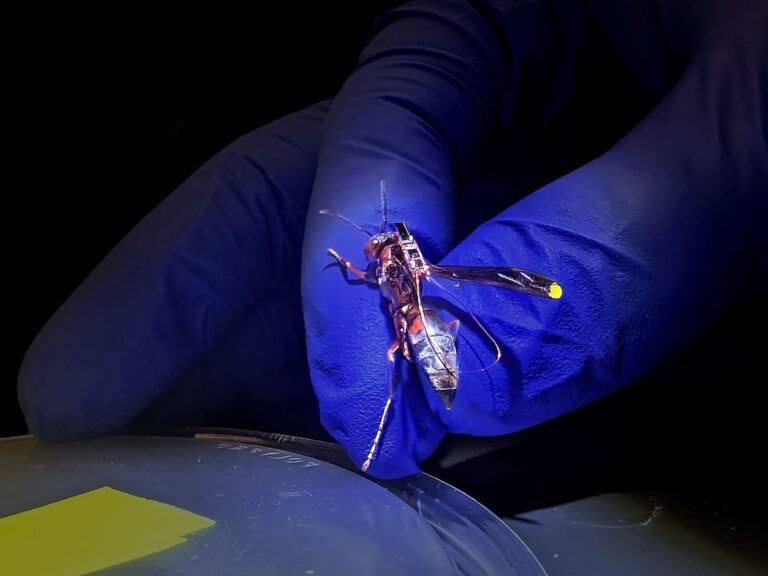
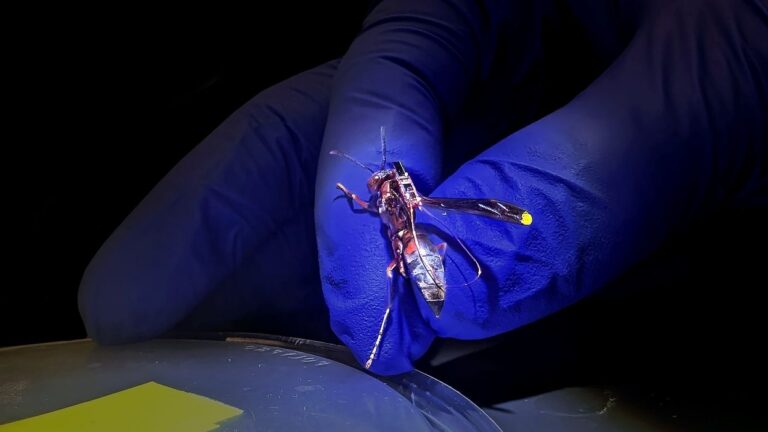
The tag is just 20 milligrams—about one third the weight of a drop of water. It was presented on 18 February at the IEEE International Solid State Circuits Conference in San Francisco by doctoral student Yi Shen, who works in the lab of University of Michigan electrical engineer David Blaauw. University of Michigan computer scientist Hun-Seok Kim developed localization algorithms to help spot the tag. Their challenge was to make an ultralightweight transmitter that had sufficient range (1.45 kilometers) and accuracy (0.9 meters) to locate these tiny insects.
They’re not the only ones trying to make more accurate, less intrusive trackers for small critters. Cellular Tracking Technologies (CTT) of Cape May, NJ, sells a 60 mg tracker that’s being used to follow the migration patterns of Monarch butterflies. This tracker uses photovoltaics paired with a capacitor and transmits a Bluetooth signal. Anyone can download an app to help track the butterflies. Other versions of the tracker are designed to be worn by nocturnal bats, and are fitted with batteries. To track birds that move during the night as well as during the day, CTT makes systems that combine photovoltaics with a rechargeable battery.
What wasps want
But even 60 mg would weigh down a wasp. “Every animal that has been tracked is much bigger than a wasp,” says Elizabeth Tibbetts, who studies their behavior and evolution at the University of Michigan. Tibbetts advised Blaauw on their design.
Honeybees and butterflies get a lot of attention, but “people forget to love wasps,” Tibbetts says. Paper wasps are a gardener’s friend. These pollinators eat nectar and prey on caterpillars. And they don’t typically sting humans.
They also have complex social lives and can even recognize each other’s faces. Tibbetts says life is different when you know that one wasp is Diana and the other is Susan, as opposed to a life where “everyone is just another wasp.” Wasps form friendships and partnerships, though some are loners. When they come out of hibernation in the spring, aggregations of about 10 wasps hang out, fight, scope each other out, and decide which others to join up with in cooperative groups. Some decide not to join a group.
Tibbetts says she and other researchers have been able to watch these complex behaviors because wasps usually return to their nests. Wasp researchers identify individuals by putting colored dots on them. “We don’t know anything about what they do when they’re not at their nests,” she says. Sometimes they don’t come back. Did Susan die, start her own nest, or join up with a different nest? With the right kind of tracker, Tibbetts hopes to find out.
Paper wasps weigh about 125 milligrams. They can carry heavy loads, ferrying caterpillars back to their nests. But Blaauw and Shen sought to keep the tag as light as possible, so that the animals can forage freely. They also had to make sure it would not interfere with the wasp’s aerodynamics, so it needed to be small in addition to lightweight.
Brendan Casey
Getting the right combination of light weight, long range, and positional accuracy was key. Jettisoning the battery was the first step. “Batteries don’t scale,” says Blaauw. A miniaturized battery can’t provide enough current to generate a strong radio signal. Capacitors, which store energy by accumulating charges on surfaces, do better at small scales, Blaauw says. “Really small capacitors can store enough charge now to send a radio pulse,” he says. The capacitor used in the wasp tag weighs just 0.86 mg. A tiny photovoltaic array slowly charges up the capacitor until it has enough energy to generate a radio signal.
The need to aggressively miniaturize the entire system created constraints on the circuit design, Shen says. During transmission, the signal can interfere with other parts of the circuit, including the controller and oscillator. So these parts are isolated from the rest of the circuit during transmission. Blaauw says designing the circuit for a specific biological application led them to come up with new design ideas that would not have occurred to them otherwise. “This problem led us to circuit innovations,” says Blaauw.
Michael Lanzone, a behavioral biologist and CEO of CTT, says the wasp tag is impressive. “A tag that weight gives the rest of us something to push for,” he says.
 The tag on programming board.Yi Shen and David Blaauw
Shen says since paper wasps are only active in the warmer months, the team rushed to test their transmitter on one of the pollinators in time to submit to their work to ISSCC. In addition to circuit designs, they used CT scans of a wasp to make sure the tag would fit on the insect and would be unlikely to interfere with its aerodynamics. A collaborator in the biology department put on two pairs of gloves to block the creature’s stinger and affixed the tag. The team took the animal outside, and it rapidly flew out of sight while they tracked it for about a kilometer and a half. So far, so good. This summer, they hope to conduct more tests.
Lanzone says he hopes the University of Michigan technology gets funding and further develops the tag to get it in the hands of researchers. “There’s a lot of cool tech that comes out of university labs, but then you don’t hear about it again. I’m excited to see if they can expand it to the next level.”
“I hope this thing works—it’s going to be so fun to use on wasps,” says Tibbetts.