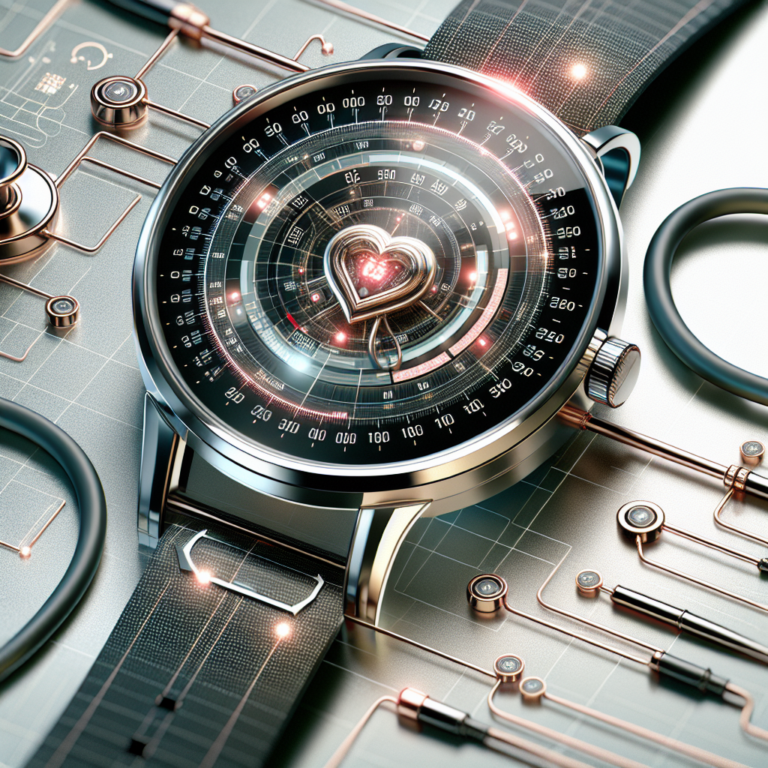
Your smartwatch can track a lot of things, but at least for now, it can’t keep an accurate eye on your blood pressure. Last week researchers from University of Texas at Austin showed a way your smartwatch someday could. They were able to discern blood pressure by reflecting radio signals off a person’s wrist, and they plan to integrate the electronics that did it into a smartwatch in a couple of years.
Beside the tried-and-true blood pressure cuff, researchers in general have found several new ways to monitor blood pressure using pasted-on ultrasound transducers, electrocardiogram sensors, bioimpedance measurements, photoplethysmography, and combinations of these measurements.
“We found that existing methods all face limitations,” Yiming Han, a doctoral candidate in the lab of Yaoyao Jia told engineers at the IEEE International Solid State Circuits Conference (ISSCC) last week in San Francisco. For example, ultrasound sensing requires long-term contact with the skin. And as cool as electronic tattoos seem, they’re not as convenient or comfortable as a smartwatch. Photoplethysmography, which detects the oxygenation state of blood using light, doesn’t need direct contact, and indeed researchers in Tehran and California recently used it and a heavy dose of machine learning to monitor blood pressure. However, these sensors are thought to be sensitive to a person’s skin tone and were blamed for Black people in the United States getting inadequate treatment during the COVID-19 pandemic.
The University of Texas team sought a non-contact solution that was immune to skin-tone bias and could be integrated into a small device.
Continuous Blood Pressure Monitoring
Blood pressure measurements consist of two readings—systole, the peak pressure when the heart contracts and forces blood into arteries, and diastole, the phase in between heart contractions when pressure drops. During systole, blood vessels expand and stiffen and blood velocity increases. The opposite occurs in diastole.
All these changes alter conductivity, dielectric properties, and other tissue properties, so they should show up in reflected near-field radio waves, Jia’s colleague Deji Akinwande reasoned. Near-field waves are radiation impacting a surface that is less than one wavelength from the radiation’s source.
The researchers were able to test this idea using a common laboratory instrument called a vector network analyzer. Among its abilities, the analyzer can sense RF reflection, and the team was able to quickly correlate the radio response to blood pressure measured using standard medical equipment.
What Akinwande and Jia’s team saw was this: During systole, reflected near-field waves were more strongly out of phase with the transmitted radiation, while in diastole the reflections were weaker and closer to being in phase with the transmission.
You obviously can’t lug around a US $50,000 analyzer just to keep track of your blood pressure, so the team created a wearable system to do the job. It consists of a patch antenna strapped to a person’s wrist. The antenna connects to a device called a circulator—a kind of traffic roundabout for radio signals that steers outgoing signals to the antenna and signals coming in from the antenna to a separate circuit. A custom-designed integrated circuit feeds a 2.4 gigahertz microwave signal into one of the circulator’s on-ramps and receives, amplifies, and digitizes the much weaker reflection coming in from another branch. The whole system consumes just 3.4 milliwatts.
“Our work is the only one to provide no skin contact and no skin-tone bias,” Han said.
The next version of the device will use multiple radio frequencies to increase accuracy, says Jia, “because different people’s tissue conditions are different” and some might respond better to one or another. Like the 2.4 gigahertz used in the prototype these other frequencies will be of the sort already in common use such as 5 GHz (a Wi-Fi frequency) and 915 megahertz (a cellular frequency).
Following those experiments, Jia’s team will turn to building the device into a smartwatch form factor and testing them more broadly for possible commercialization.